
No one ever asked what brand the door was.
In the homes of an older India, a guest did not walk in and check whose name was on the furniture. There was no name. There was only the wood, and everyone in the room understood, without being told, exactly what they were looking at. Teak, heavy and dark, aged into a color no varnish could fake. Sagwan, grained like something that had taken its time. The kind of wood that had a history before it ever became a chair.
This was the flex. Not the brand. The material, its purity, its weight, its honesty about what it was.
Walk into an old Indian home and notice what is actually being displayed.
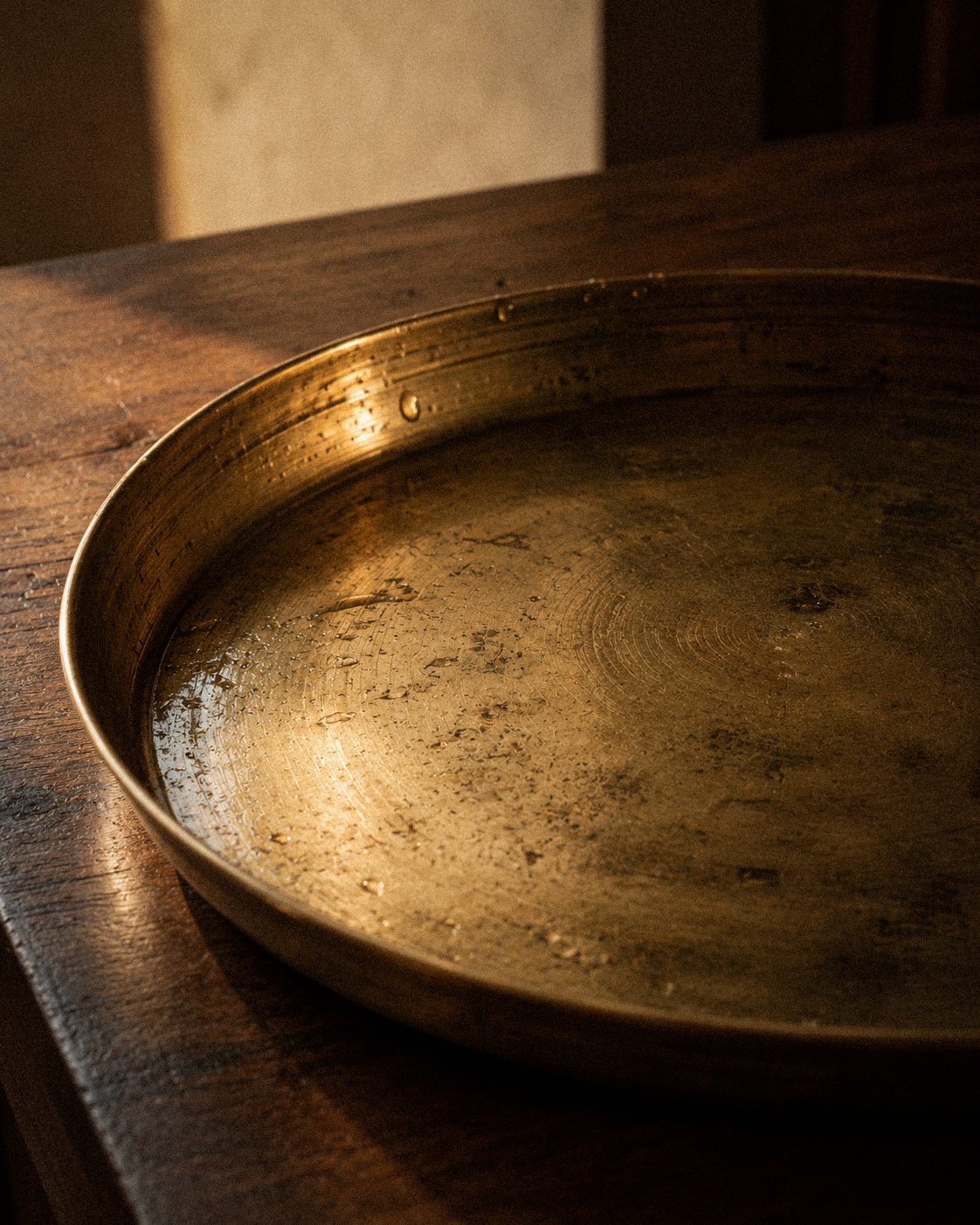
The brass is being displayed. Not because it sparkles, but because someone has been polishing it since before you arrived, and that labor is visible, and that visibility was the point. The wood is being displayed. Not lacquered into anonymity, but left to show its grain, its knots, the small evidence that it came from a tree and not a factory.
Nothing was imported to impress you. Nothing carried a logo. The pride was never, look what we bought. The pride was, look what this is made of, and look how long we have kept it well.
This is a different kind of luxury than the one we have inherited now.
Today, when a home is being built, the conversation often goes through an architect, and the architect's promise is usually the same: top-tier materials, the best brands, imported finishes. The kitchen becomes modular and gleaming. The plates become porcelain or melamine, light enough to lift with one finger, impossible to repair if they crack.
This is not a wrong way to live. It is simply a different relationship with things. The modern material asks nothing of you. It does not rust, so it does not need tending. It does not crack from age, because it never truly ages, it only eventually fails, all at once, and is replaced.
The old materials asked something of you in return for their beauty. The brass would tarnish if neglected. The wood would dry and crack without oil. Care was not optional, it was the relationship. And the home that resulted from that relationship had a different kind of beauty. Not the beauty of something new. The beauty of something kept.
There is a kind of honesty in a material that shows its age.
A brass plate after twenty years of use does not hide that it has been used. It carries water spots, the soft dullness that only repeated handling creates, sometimes a thin green at the edges before the next cleaning. And somehow, none of this reads as decay. It reads as evidence. Evidence of a life lived around that object, of meals served, of hands that washed it, of a person who decided, today as on every day before, that this object was worth the five extra minutes of care.
A plastic plate, by comparison, does not age. It simply waits to be thrown away.
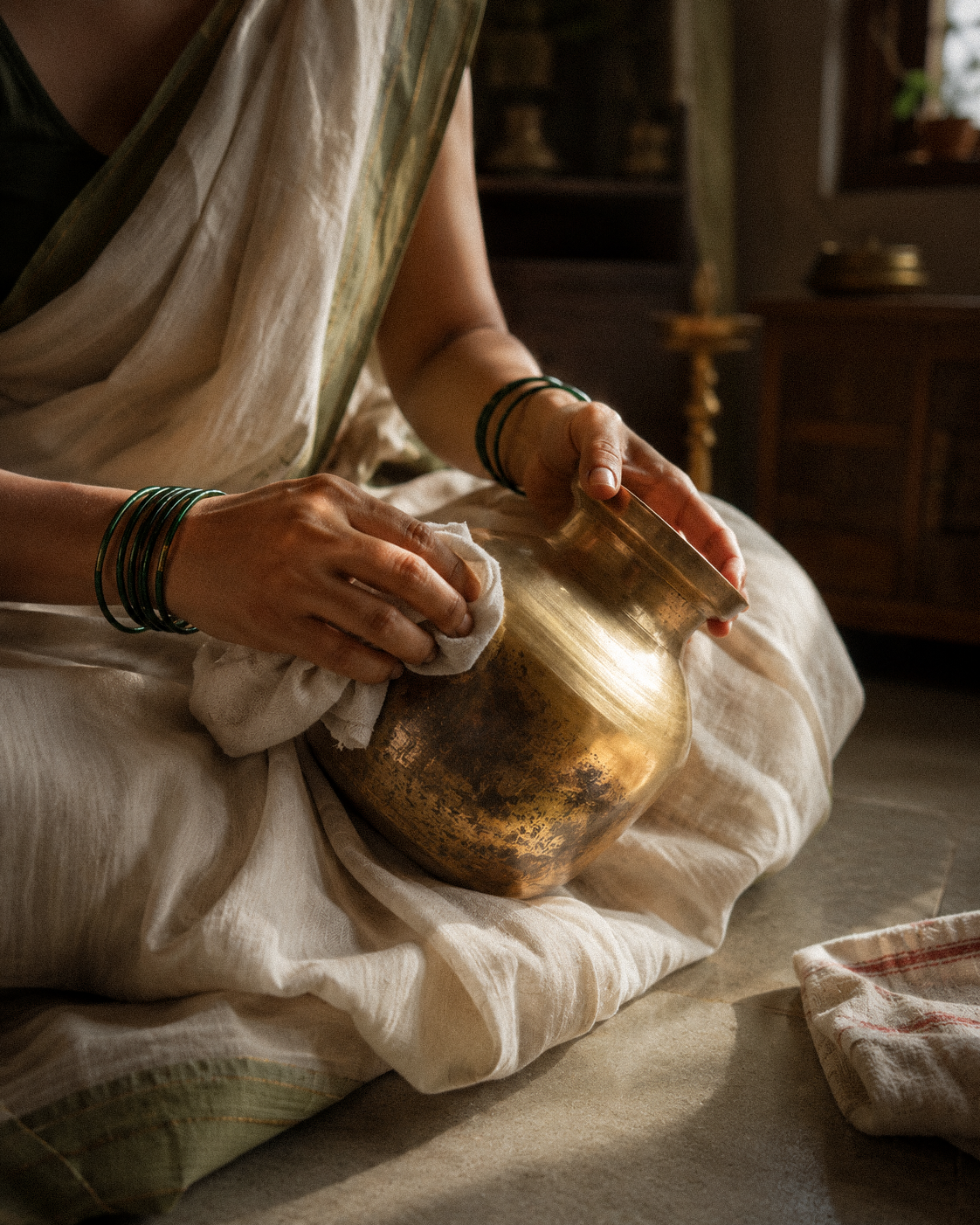
What the old homes understood, perhaps without ever saying it aloud, is that living materials hold memory, and dead materials do not.
Wood remembers the humidity of every monsoon it has survived. Brass remembers every hand that has held it. Stone floors remember the weight of footsteps repeated for decades, smoothing slightly with each year. These materials are, in a very real sense, alive, not biologically, but relationally. They change because of their relationship with the people who use them. And that change is what gives a home its soul.
A home filled entirely with materials that cannot change, cannot age, cannot show care, is, in some quiet way, a home without memory. It can be beautiful. It can be comfortable. But it will never carry the particular warmth of a thing that has been kept, not just bought.
This is not an argument against modern living.
The flats we live in now solve real problems: space, affordability, practicality, the demands of a different century. No one is asking anyone to return to a world without modular kitchens or easy-to-clean surfaces.
But it is worth asking, occasionally, what we traded when we made that shift. Not as regret. As awareness.
Because somewhere in that older idea of luxury, pure material, deep care, a beauty that depended on tending rather than replacing, there is something worth carrying forward, even into a thoroughly modern home. A single brass vessel on a shelf. A wooden table left unlacquered enough to show its grain. One object in the house that asks something of you, and rewards that asking with a kind of beauty that nothing imported ever quite achieves.
The old homes were not poorer for having less. They were rich in a currency we have mostly stopped counting.
Across the older homes of India, prosperity was never measured by what was acquired from elsewhere, but by the purity of what was already here, and the care with which it was kept. Perhaps the truest inheritance is not the object itself, but the discipline of tending to it.