
There is a particular quality of silence that exists only at five in the morning. Not the silence of absence; the city is already murmuring, a distant truck, a temple bell two streets over, a crow finding its first complaint of the day. It is the silence of things not yet begun. A silence that holds its breath. That waits, with a kind of patient intelligence, for someone to give it shape.
In a flat in Mumbai, a young woman wakes into that silence every morning. She does not reach for a phone. She does not turn on a light. She moves through the apartment the way people who have known a space for years move through it without looking, without thinking, guided by some bodily knowledge older than habit. She washes. She folds herself into a cotton dupatta. And then she does the thing that organises everything else that will follow in the day: she lights the samai.
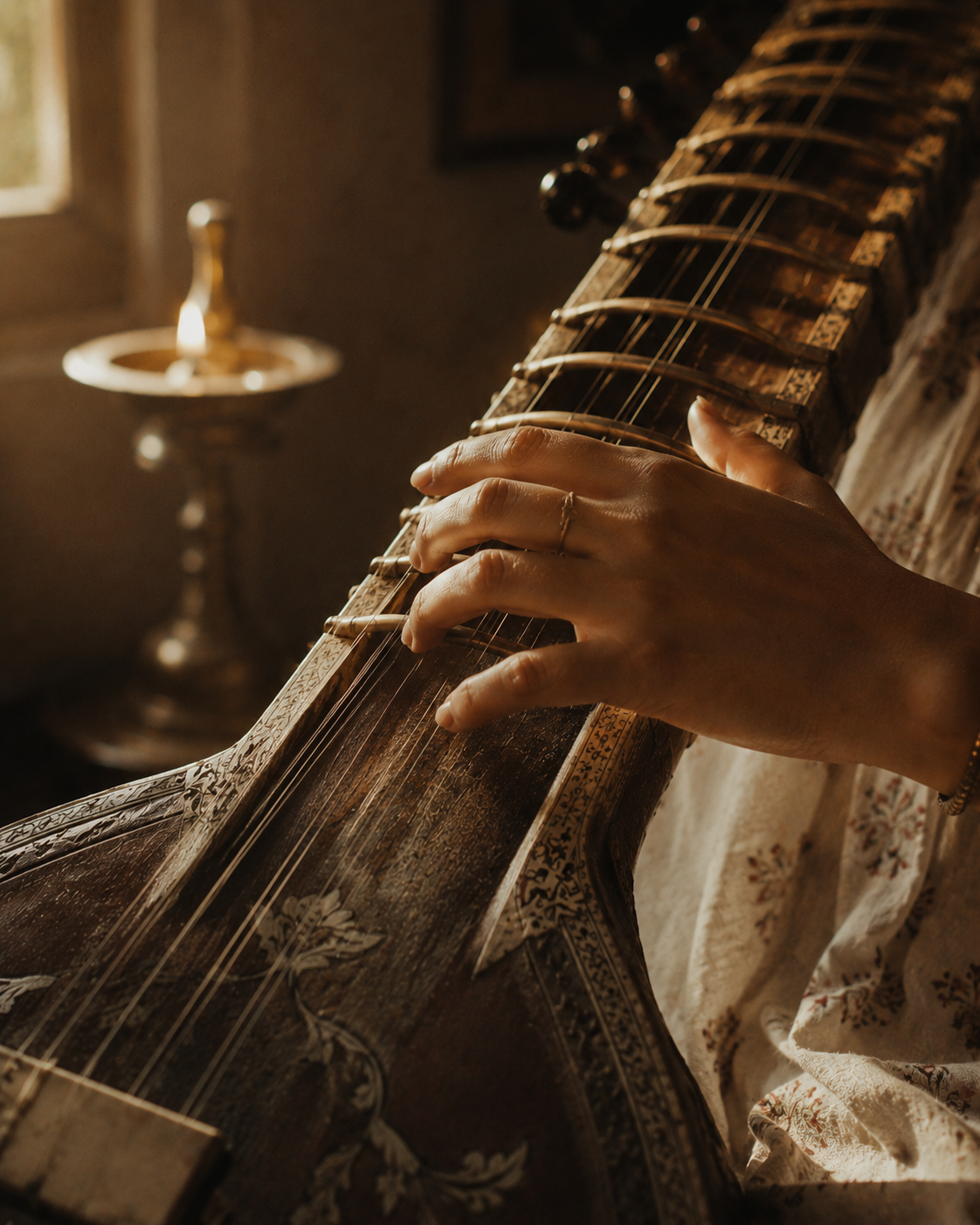
The samai is a traditional oil lamp, brass usually, worn to the colour of old honey by years of handling. It holds a single wick. The flame it gives is small and serious, nothing like the flat overhead light that would come later. It is the kind of light that makes a room feel inhabited rather than illuminated. The kind that makes shadows lean toward you rather than away.
She places it near the sitar. This, too, is not accidental. The instrument rests against the wall the way a person rests, leaning slightly, at ease, carrying its age without apology. The sitar is old enough to have been played by someone before her. Old enough to carry a sound memory in its gourd, in the grain of its teak neck, in the slightly worn hollows where the fingers have pressed thousands of times. She settles before it. She adjusts. And then, in the lamplight, with the city still half-asleep outside the window, she begins the riyaaz.
Riyaaz is often translated as practice. But the word practice does not hold what riyaaz actually means.
Practice suggests preparation for something you do before the real thing. Riyaaz is the real thing. It is the daily act of returning to the form. Keeping faith with the learning. It is closer, in its seriousness and its intimacy, to prayer than to rehearsal. You do not do riyaaz to get better. You do riyaaz because the music requires your presence every morning, and you do not wish to let it down.
Her father spoke of this to a friend one evening, after a bhajan, in that unhurried way that people speak when the music has just ended and the room is still full of it. He described his daughter's morning without sentimentality. Simply, the way you describe something you love too much to decorate. The samai. The hour. The voice finding its way through the first phrases of the raga, uncertain at first, then deepening, the way a river deepens as it moves away from its source.
And the voice travels, he said. Through the room, into the corridor, under the door of the room where her younger brother still sleeps. It is the sound that wakes the house. Not as an interruption. As an arrival. As the morning's first offering, given before the day has asked for anything yet.
I have been thinking about that image since I heard it. The lamp. The sitar. The five o'clock silence being given a shape by a young woman who has chosen. Chosen, every morning, against every easier option, to begin her day in conversation with something ancient. Not because someone is watching. Not for a performance, or an exam, or an audience. But because this is what the morning requires. Because this is what she requires.
There is a word in Sanskrit: Abhyasa. It means sustained, devoted practice. The Bhagavad Gita speaks of it not as discipline but as love in action. As the thing you return to not out of obligation but out of recognition: that this is where you belong, that this is the form your attention takes when it is most fully itself.
Riyaaz is Abhyasa. And Abhyasa, done daily and in earnest, changes the practitioner. Not all at once. Slowly, the way a river changes the stone it runs over. Not by force, but by returning.
In the classical Indian tradition, the space of riyaaz is considered sacred not because it is set apart from daily life, but because it is continuous with it. The lamp that is lit for practice is the same lamp that is lit for prayer. The ragas are organised by hour. The Bhairav for dawn, the Yaman for dusk, because music was never separated from the rhythm of living. To practice at five in the morning is not merely a scheduling choice. It is a statement about what you believe the morning is for.
Not the concert. Not the stage. The five o'clock lamp.
What moves me most about the image her father described is not the talent, or the discipline, or even the beauty of the voice itself. It is the smallness of it. The lamp. One wick. One room. One person and one instrument in conversation with each other while the city dreams its last hour of sleep. Nothing grand. Nothing performed. Just a young woman keeping faith with something she received, and passing it forward into the morning air whether anyone is listening or not.
This is what Maati is here to find. Not the concert. Not the stage. The five o'clock lamp. The first phrase of the raga, uncertain, then deepening. The voice travelling under the door.